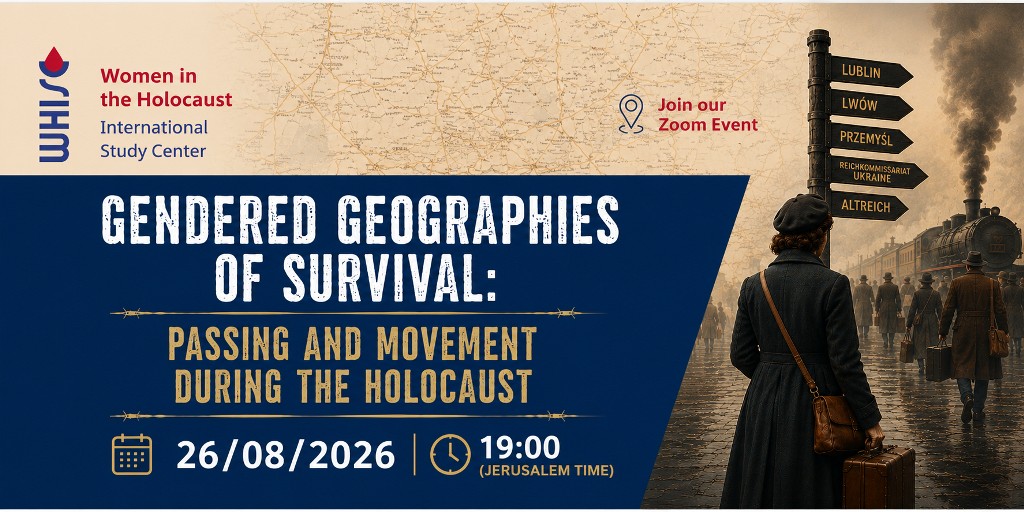
Exploring three distinct cases, this panel addresses questions of gender and geography and their impact on identity passing among Jews responding to Nazi persecution from the summer of 1942 onward. Together, the papers trace movements across wartime borders—from Przemyśl to Lublin, from Lwów into the “Reichskommissariat Ukraine,” and from Lublin to the German “Altreich”—to show how occupation zone, gender, kinship networks, and destination shaped Jewish responses and passing practices during the Holocaust. By examining these intersecting factors, the panel highlights how gendered and spatial dynamics defined both the possibilities and limits of passing under German occupation.
Now Available to Watch: Gendered Geographies of Survival
Moderator
Dr. Mehak Burza
Presentations
Ayelet Eva Herbst
“You’ve got to trust me, it’s much easier for men”: Escape, Survival and Gender Dynamics on the Lwów–Dnipropetróvsk Rescue Trail, 1942–1943
When examining the escape and survival of Polish Jews in occupied Ukraine, female voices are conspicuously absent. A qualitative analysis of ego-documents reveals that not only significantly fewer Jewish women escaped to occupied Ukraine, but that the few who did were almost entirely dependent on their male counterparts. Polish-Jewish women appear to have reached occupied Ukraine either in predominantly male groups or with male companions. This presentation explores the scarcity of women on escape routes to occupied Ukraine and the conditions that underlie their reliance on men. For this purpose, the paper examines female passers and escapees on the Lwów–Dnipropetróvsk rescue trail, considering their roles and gender dynamics as mothers, spouses, younger siblings, and friends.
Hana Green
“A City Where Nobody Knows Me”: Gender, Geography, and Family Strategies of Passing during the Holocaust
When the ever-resourceful Stella Rinde finally convinced her husband, Maurice, that it was time for the family to flee Przemyśl, Poland, he concluded that he needed to find a city where he had never been before and where nobody knew him. He landed on Lublin. Soon after, the family—parents Stella and Maurice and their children John and Irene—fled the nearly 250 kilometers from Przemyśl to Lublin together, where they remained through liberation in July 1944. This presentation explores the gendered and geographic dynamics of identity passing through the experiences of a single family unit, considering age- and gender-specific passing strategies, their various roles in maintaining their deception and accessing resources, and how the local social and political context affected women and girls differently from men and boys.
Lauren Fedewa
“Too Many to Hide?”: Familial, Gender, and Group Dynamics among Ethnic Polish Women and Jewish Women Passing as Poles from Lublin to IG Farben-Bitterfeld
This presentation follows Kitty Hart-Moxon (born Felix), her mother Rosa Felix, and eleven other Jewish women and girls who, while passing as ethnic Poles, joined a labor transport from Lublin, Poland, to Bitterfeld, Germany, as Polish Christian civilian forced laborers. Drawing on Hart-Moxon’s first-person accounts, it traces the group’s journey from labor recruitment in Lublin in November 1942 to their detection and arrest at the IG Farben plant in Bitterfeld, ending with their transfer to Auschwitz-Birkenau in April 1943. The paper examines how familial, gender, and group dynamics shaped their escape from occupied Poland to Germany, their individual and collective passing efforts, and their experiences in prisons and Auschwitz. In doing so, it reveals the possibilities and limits of familial and group passing attempts among Jews living under assumed Polish identities as civilian forced laborers in the German “Altreich.”
About the Speakers
Ayelet Eva Herbst
Ayelet Eva Herbst is a PhD candidate at Ludwig Maximilian University’s Historical Seminar and Institute of Eastern and Southeastern European History. She has received scholarships and awards from institutions including the Ernst Ludwig Ehrlich Studienwerk, the Simon Wiesenthal Institute for Holocaust Studies, Yad Vashem, and the Lviv Institute for Urban History of East Central Europe. As a Fellow of the Claims Conference’s Saul Kagan Fellowship in Advanced Holocaust Studies, Herbst is currently finalizing her dissertation on the flight of Polish Jews to Nazi-occupied Ukraine. Her research focuses on the Holocaust in Ukraine and Jewish experiences of flight and displacement during the Second World War, the Holocaust, and its aftermath. Between 2017 and 2022, she conducted research for the German Foreign Ministry’s Protecting Memory project, which identified, marked, and documented more than 15 mass-grave sites across present-day Ukraine.
Hana G. Green
Hana G. Green is an Assistant Professor of Modern European History at Texas A&M University–San Antonio. Previously, she was the inaugural Rose Mibab and Carl Goldberg Postdoctoral Fellow at the Zucker/Goldberg Center for Holocaust Studies at the College of Charleston. A socio-cultural historian of the Holocaust and modern Jewish history, her research explores Jewish responses to persecution, identity formation, migration, and intercultural exchange. She is currently adapting her dissertation on Jewish identity passing in Central Europe during the Holocaust into a book manuscript. She holds a PhD from Clark University, an MA from the University of Haifa, and a BA from the University of Florida.
Lauren Fedewa
Lauren Fedewa is an independent researcher and recent PhD graduate from the Department of History and the Anne Tanenbaum Centre for Jewish Studies at the University of Toronto. She specializes in Holocaust and genocide studies, modern Jewish history, and twentieth-century European history, with a focus on identity passing and forced labor during World War II. Her doctoral dissertation examines Jewish women and girls who attempted to survive by passing as Polish Christian civilian forced laborers in Germany. Fedewa was a fellow at the Women and the Holocaust International Study Center at Moreshet during the 2025–2026 academic year. She holds a PhD in History from the University of Toronto, an MA in History from the University of Vermont, and a BA in History and Germanic Studies from the University of Maryland.