
Moderator
Dr. Professor Lily Zamir,
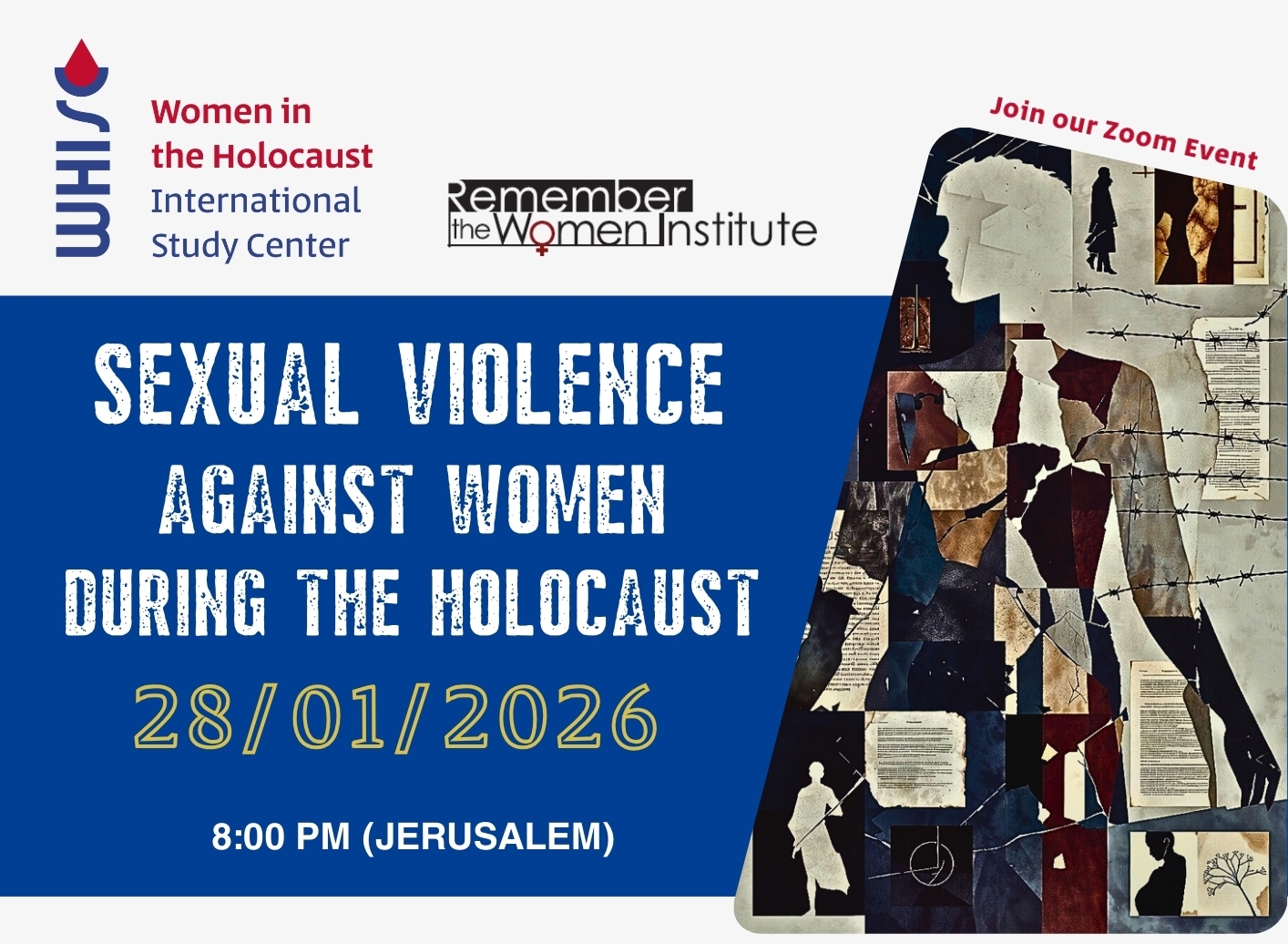
In her opening lecture, Professor Zamir presented a broad historical and cultural framework for understanding sexual violence against women across time. She examined how the female body has repeatedly been used as a symbolic battlefield — a site of domination, humiliation, and conquest — from biblical narratives through modern conflicts.
She emphasized that in many patriarchal societies, violence against women has been tied to national identity, honor, and collective humiliation. Survivors often faced stigma and silence, both during and after the Holocaust, which contributed to the scarcity of testimonies. The lecture concluded with a call to acknowledge the voices of survivors and the moral responsibility to believe their testimonies and give them historical presence.
[Watch the recording]
Professor Havryshko explored sexual violence during the Holocaust through the lens of women’s agency within extreme conditions. Drawing on testimonies and archival research, she demonstrated that sexual violence functioned as a tool of terror, punishment, domination, and ethnic persecution. It took many forms beyond rape, including coercion, exploitation, and reproductive violence.
At the same time, she highlighted the complexity of survival strategies. Some women resisted directly, while others made painful and constrained choices in order to survive or protect family members. These actions, she emphasized, should be understood as forms of agency within impossible circumstances. Her lecture also addressed the culture of disbelief and blame that survivors faced after the war, and the importance of recognizing their struggle for justice and testimony.
[Watch the recording]
|
Dr. Rochelle G. Saidel is the founding Executive Director of Remember the Women Institute, a New York–based nonprofit organization that for over 28 years has advanced research and cultural projects integrating women into history, particularly Holocaust history. Her pioneering scholarship on sexual violence against Jewish women during the Holocaust culminated in the co-edited volume Sexual Violence against Jewish Women during the Holocaust, the first book devoted entirely to this subject. She is the author or editor of seven additional books, including The Jewish Women of Ravensbrück Concentration Camp. Dr. Saidel has been a Research Fellow at Yad Vashem and coordinated VIOLATED! Women in Holocaust and Genocide, an international art exhibition, among other major projects.
Dr. Sonja M. Hedgepeth, recently retired Professor of German at Middle Tennessee State University, is co-editor of Sexual Violence against Jewish Women during the Holocaust and serves on the Executive Board of the Remember the Women Institute. Her scholarly expertise lies in German literature and cultural history. She is the author of a German-language monograph on German-Jewish writer Else Lasker-Schüler, whose works were burned by the Nazis in 1933. Dr. Hedgepeth has also played a significant role in advancing Women’s Studies and Holocaust Studies through international conferences and academic leadership.
Dr. Saidel and Dr. Hedgepeth first met as National Endowment for the Humanities Visiting Scholars during a 1996 summer seminar at Brandeis University. For nearly three decades, they have collaborated as colleagues and lecturers, engaging international audiences on women’s experiences during the Holocaust.
Prof. Marta Havryshko is a historian and the Dr. Thomas Zand Visiting Assistant Professor in Holocaust Pedagogy and Antisemitism Studies at the Strassler Center for Holocaust and Genocide Studies, Clark University. She previously served as Director of the Institute at the Babyn Yar Holocaust Memorial Center in Kyiv. Her research appointments include fellowships and visiting positions at institutions such as the United States Holocaust Memorial Museum, Yad Vashem, the Vienna Wiesenthal Institute for Holocaust Studies, the German Historical Institute Warsaw, and others. Dr. Havryshko has published extensively on World War II, the Holocaust, nationalist movements, and sexual violence in war and genocide, and is currently developing a book on sexual violence during the Holocaust in Ukraine.
This panel is intended for scholars, educators, students, and all those engaged in Holocaust studies, gender studies, and the ethics of historical testimony.
We look forward to your participation.